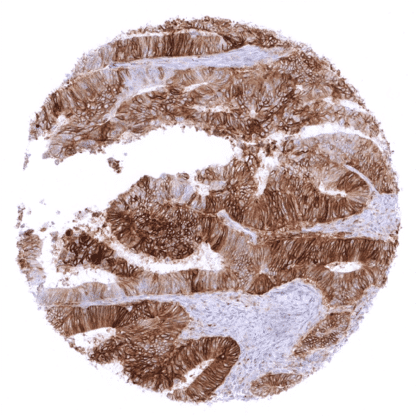
PD-L1 (MSVA-711R)
Recombinant Rabbit monoclonal / IgG 1:100 – 1:200 Research Use Only Predominantly membranous Human MSVA-711R B7 homolog 1; B7-H1; CD274; PD-L1; PDCD1 ligand 1; PDCD1L1; PDCD1LG1; Programmed cell death 1 ligand 1 Alveolar macrophages, tonsil crypt epithelium and the placental cytotrophoblast show strong, predominantly membranous positivity. Follicle centre macrophages should show at least moderate intensity staining. Appendix (negative staining of all epithelial cells) PD-L1 is a pivotal protein in immune-oncology. Programmed death-ligand 1 (PD-L1) is a 40kDa type 1 transmembrane protein that plays a major role in suppressing the adaptive immune system. Normally, the adaptive immune system reacts to antigens that are associated with immune system activation by exogenous or endogenous danger signals. In turn, clonal expansion of antigen-specific CD8+ T cells and/or CD4+ helper cells is propagated. The binding of PD-L1 to the inhibitory checkpoint molecule PD-1 provides an inhibitory signal to lymphocytes. This lowers the proliferation of antigen-specific T-cells in lymph nodes, while simultaneously decreasing apoptosis in regulatory T cells (anti-inflammatory, suppressive T cells). Upregulation of PD-L1 in tumor cells and/or tumor associated macrophages represents a major mechanism by which cancers can evade the host immune response and consecutive tumor cell killing by tumor infiltrating CD8+ T cells or natural killer (NK) cells. Various antibody drugs targeting PD-1 and PD-L1 (immune checkpoint ... PD-L1 staining pattern in Normal Tissues with antibody MSVA-711R (Images shown in our “Normal Tissue Gallery”) Brain Cerebrum Negative. Cerebellum Negative. Endocrine Tissues Thyroid Negative. Parathyroid Negative. Adrenal gland Negative. Pituitary gland Moderate staining of a subset of epithelial cells in the adenohypophysis. Respiratory system Respiratory epithelium Negative. Lung Intense staining of alveolar macrophages. Epithelial cells are negative. Gastrointestinal Tract Salivary glands Negative. Esophagus Negative. Stomach Negative. Duodenum Moderate to strong staining in macrophages. Epithelial cells are negative. Small intestine Moderate to strong staining in macrophages. Epithelial cells are negative. Colon Moderate to strong staining in macrophages. Epithelial cells are negative. Rectum Moderate to strong staining in macrophages. Epithelial cells are negative. Liver Negative. Gallbladder Negative. Pancreas Negative. Genitourinary Kidney Negative. Urothelium Negative. Male ge... In cancer tissues, patterns of aPD-L1 immunostaining are highly heterogeneous. Staining can involve both cancer cells and tumor associated macrophages. Sometimes these cells types can be difficult to distinguish in brightfield immunohistochemistry. The PD-L1 staining in cancer cells can show variable intensity and may involve the entire tumor or only fractions of it. In some tumors with incomplete staining, positive tumor cells are predominantly or exclusively seen at the invasive border. PD-L1 staining in tumor associated macrophages is also variable and often patchy. In some instances, PD-L1 negative cancer cells are surrounded by a dense layer of strongly PD-L1 expressing cells. The TCGA findings on PD-L1 RNA expression in different tumor categories have been summarized in the Human Protein Atlas. Colorectal adenocarcinoma with moderate to strong membranous PD-L1 staining in the vast majority of tumor cells. Strong focal PD-L1 staining in tumor associated inflammatory cells in a bas... PD-L1 (MSVA-711R) publication summary: Publications used for data compilation: Möller et al. “High density of cytotoxic T-lymphocytes is linked to tumoral PD-L1 expression regardless of the mismatch repair status in colorectal cancer”. Published in Acta Oncologica. 2021;60(9):1210-1217. Möller et al. “Tumor cell PD-L1 expression is a strong predictor of unfavorable prognosis in immune checkpoint therapy-naive clear cell renal cell cancer”. Published in International Urology and Nephrology. 2021;53(12):2493-2503. Möller et al. „PD-L1 expression and CD8 positive lymphocytes in human neoplasms: A tissue microarray study on 11,838 tumor samples”. Published in Cancer Biomarkers. 2023;36(2):177-191. In these three studies, a total of 14654 tumors from 118 different tumor types were analyzed using the following protocol: Heat-induced antigen retrieval for 5 minutes in an autoclave at 121°C in pH9 Target Retrieval Solution buffer. MSVA-711R was applied at a dilution of 1:150 at 37°C for 60 min... IHC users have different preferences on how the stains should look like. Some prefer high staining intensity of the target stain and even accept some background. Others favor absolute specificity and lighter target stains. Factors that invariably lead to more intense staining include higher concentration of the antibody and visualization tools, longer incubation time, higher temperature during incubation, higher temperature and longer duration of the heat induced epitope retrieval (slide pretreatment). The impact of the pH during slide pretreatment has variable effects and depends on the antibody and the target protein. All images and data shown here and in our image galleries are obtained by the manual protocol described below. Other protocols resulting in equivalent staining are described as well. Manual protocol Freshly cut sections should be used (less than 10 days between cutting and staining). Heat-induced antigen retrieval for 5 minutes in an autoclave at 121°C in pH 7,8 Target ... Given the role of PD-L1 as a pivotal immune checkpoint, PD-L1 is of critical interest in immuno-oncologic research. The quantity of PD-L1 expressing tumor and inflammatory cells and their spatial relationship with effector cells is under investigation for predicting response to immune checkpoint inhibitors targeting the PD1/PD-L1 axis. Specificity of MSVA-711R is documented by strong positive staining in cell types that are well documented to express PD-L1 such as dendritic cells and macrophages of lymphoid tissues, alveolar macrophages of the lung, squamous epithelia of the tonsil crypts, littoral cells in the spleen and the syncytiotrophoblast of the placenta. In addition, PD-L1 staining in absent in these tissues known to not express PD-L1 including tissues notorious for non-specific IHC background such as kidney, colonic mucosa, and epidermis. Normal tissue gallery