PSAP (MSVA-452M)
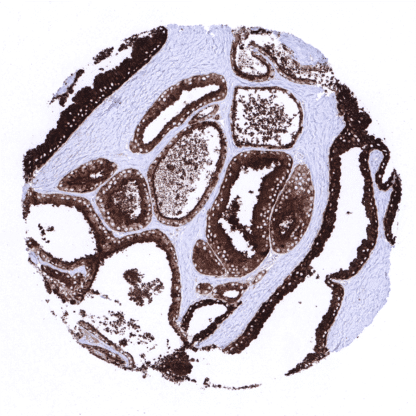
Recombinant Mouse monoclonal / IgG1 1:100 – 1:200 Research Use Only Cytoplasmic Human MSVA-452M 5′-nucleotidase (5′-NT); Acid phosphatase prostate; ACP3; Ecto-5′-nucleotidase; Prostatic acid phosphatase (PAP); Prostatic acid phosphatase; Thiamine monophosphatase (TMPase) Prostate:A strong PSAP immunostaining should, be seen in all glandular cells. Appendix: All epithelial and non-epithelial structures must not show any PSAP immunostaining. PSAP is expressed in normal and neoplastic acinar cells of the prostate. Prostatic specific acid phosphatase (PSAP), also termed Prostatic acid phosphatase (PAP) is coded by a gene at 3q21-23. It is an enzyme that is produced in prostate epithelial cells and has the capacity to dephosphorylate macromolecules in acidic conditions (pH 4-6). Its substrates are not fully known. It is suspected, that PSAP’s physiological function may be related to the liquefaction process of semen. Alternative splicing generates two types of PAP transcripts, a transmembrane PAP consisting of 11 exons, and cellular and a secretory PAPs containing 10. The molecular mechanisms controling PSAP protein expression are not fully understood. Factors involved in the regulation of PSAP expression include androgen, androgen receptor, NF-κB, TNF-a and IL-1. In normal tissues, PSAP is found in prostate glandular cells and at a lower level in sebaceous glands. PSAP immunostaining is absent in all other tissues including all epithelial cells of the gastrointestinal and the genitourinary tract, fallopian tubes, endometrium, endocervix, placenta, gallbladder, liver, pancreas, salivary and bronchial glands, breast gland, Brunner glands, thyroid, pituitary gland, adrenal gland, parathyroid gland, testis, epididymis, seminal vesicle, non-keratinizing and keratinizing squamous epithelium of various different sites, skin appendices, all mesenchymal tissues, hematopoetic and immune cells, and the brain. These findings are largely comparable to the RNA and protein data described in the Human Protein Atlas (Tissue expression PSAP) Suggested positive tissue control : Prostate: A strong PSAP immunostaining should, be seen in all glandular cells. Suggested negative tissue control: A ppendix: All epithelial and non-epithelial structures must not show any ... PSAP is expressed in the vast majority of adenocarcinomas of the prostate. The prevalence of positive cases was described to decrease slightly with increasing Gleason score. PSAP is also described to be positive in tumors derived from the Skene’s glands, and in a fraction of salivary gland tumors. PSAP positivity was also described to potentially occur in nephrogenic adenoma, as well as male and female breast cancers. The TCGA findings on PSAP RNA expression in different tumor categories have been summarized in the Human Protein Atlas. PSAP negative gastric adenocarcinoma. (intestinal type). PSAP negative muscle-invasive urothelial carcinoma of the urinary bladder. Prostatic adenocarcinoma (Gleason 5+5=10) with weak to moderate PSAP immunostaining. Cancer tissue gallery PSAP (MSVA-452M) publication summary Relevant publication: Tribian et al. “Diagnostic Role and Prognostic Impact of PSAP Immunohistochemistry: A Tissue Microarray Study on 31,358 Cancer Tissues” Published in Diagnostics (Basel). 2023 Oct 18;13(20):3242. PMID: 37892063 A total of 25,801 tumors from 127 different tumor categories were successfully analyzed by using the following protocol: Heat-induced antigen retrieval for 5 minutes in an autoclave at 121°C in pH 7,8 Target Retrieval Solution buffer. MSVA-452M at a dilution of 1:150 at 37°C for 60 minutes. Visualization of bound antibody by the EnVision Kit (Dako, Agilent). This protocol was also used for all stainings depicted in our tumor and normal tissue galleries. PSAP staining was almost exclusively seen in prostate cancers, and only occurred in 2 of the 127 evaluated extra-prostatic tumor categories (diffuse-type gastric adenocarcinoma and neuroendocrine tumors of the pancreas). The distribution of positive staining results is sho... IHC users have different preferences on how the stains should look like. Some prefer high staining intensity of the target stain and even accept some background. Others favor absolute specificity and lighter target stains. Factors that invariably lead to more intense staining include higher concentration of the antibody and visualization tools, longer incubation time, higher temperature during incubation, higher temperature and longer duration of the heat induced epitope retrieval (slide pretreatment). The impact of the pH during slide pretreatment has variable effects and depends on the antibody and the target protein. Accordingly, multiple different protocols can generate identical staining results. All images and data shown here and in our image galleries are obtained by the manual protocol described below. Other protocols resulting in equivalent staining are described as well. Manual protocol Freshly cut sections should be used (less than 10 days between cutting and staining). Heat... The diagnostic utility of PSAP expression analysis should be investigated in a large cohort of tumors from different entities. The prognostic role of PSAP expression levels in tissue and serum are not entirely clear. Specificity of MSVA-452M is documented by strong positive staining in cell types that are well documented to express PSAP such as prostate epithelium and of sebaceous glands and absence of staining in all other tissues including those being notorious for non-specific IHC background such as kidney, colonic mucosa, and epidermis. Normal tissue gallery