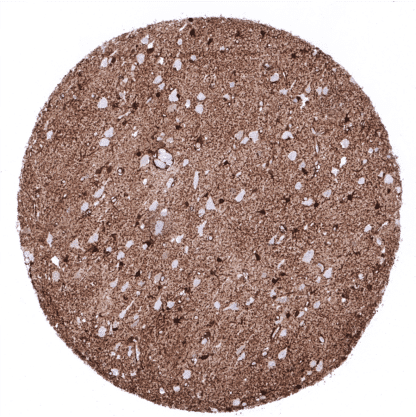
S100 (MSVA-490R)
Recombinant Rabbit monoclonal / IgG 1:100 – 1:200 Research Use Only Cytoplasmic (and membranes/nuclei) Human MSVA-490R NEF; Protein S100-B; S-100 protein beta chain; S100 calcium binding protein beta (neural); S100 calcium-binding protein B; S100 protein beta chain; S100B; S100beta Appendix: Schwann cells of peripheral nerves and adipocytes should show a strong, predominantly cytoplasmic S100B staining. Appendix: Smooth muscle and epithelial cells must not show any S100B staining. The S100 genes are a group of water soluble low-molecular-weight proteins characterized by two calcium-binding sites that have a specific helix-loop-helix (“EF-hand type”) conformation. The “S100” gene name is derived from the fact that these proteins are soluble in 100%. There are at least 21 family members but because most cells containing S100 protein also express the beta chain, S100B has become almost synonymous with S100 protein. S100 beta is coded by a gene at chromosome 21q22. Its functions involve microtubule assembly, cation diffusion across lipid membranes, and RNA polymerase activity. In diagnostic pathology, S100B – also termed “S100” – is used as a marker for Schwann cells and melanocytes. In these cell types, S100B is highly expressed, however, S100B is also regularly seen in various other cell types. The S100 genes are a group of water soluble low-molecular-weight proteins characterized by two calcium-binding sites that have a specific helix-loop-helix (“EF-hand type”) conformation. The “S100” gene name is derived from the fact that these proteins are soluble in 100%. There are at least 21 family members but because most cells containing S100 protein also express the beta chain, S100B has become almost synonymous with S100 protein. S100 beta is coded by a gene at chromosome 21q22. Its functions involve microtubule assembly, cation diffusion across lipid membranes, and RNA polymerase activity. In diagnostic pathology, S100B – also termed “S100” – is used as a marker for Schwann cells and melanocytes. In these cell types, S100B is highly expressed, however, S100B is also regularly seen in various other cell types. S100 protein can be found in cell membranes, cytoplasm and nuclei. S100 immunostaining shows strong positivity in cerebrum, cerebellum, neurohypophysis, peripheral nerves (Schwann cells) which are visible in most organs, myoepithelial cells of salivary glands and breast glands, fat cells, Langerhans cells, sustentacular cells, melanocytes, chondrocytes, subsets of dendritic cells and lymphocytes as well as serous cells in bronchial glands. A weaker S100 staining is seen in adrenal medullary cells, a fraction of cells in the adenohypophysis, and occasionally also in Sertoli cells of the testis, a fraction of islet cells of the pancreas, and breast luminal cells. These findings are largely consistent with RNA and protein data summarized in the Human Protein Atlas (Tissue expression S100) . Suggested positive tissue control : A ppendix: Schwann cells of peripheral nerves and adipocytes should show a strong, predominantly cytoplasmic S100 staining. Suggested negative tissue control: A p pe... S100 expression is seen in many different tumor types. A positive S100 immunostaining is particularly frequent in brain tumors of various types, benign and malignant melanocytic tumors, Schwannoma, neurofibroma, granular cell tumor, myoepithelial tumors, Langerhans cell histiocytosis, benign and malignant lipomatous tumors, primitive neuroectodermal tumors, neuroblastoma, clear cell sarcoma, rhabdomyosarcoma, chordoma, chondroid tumors, sweat gland carcinoma, Sertoli-Leydig cell tumors, synovial sarcoma, Ewing sarcoma, meningioma, and neuroendocrine tumors. S100 positivity also occurs in a variable fraction of various different epithelial tumors. The TCGA findings on S100 RNA expression in different tumor categories have been summarized in the Human Protein Atlas. Pheochromocytoma with moderate to strong S100 positivity of tumor cells. A positive staining is also seen in intratumoral nerve fibres. Neuroendocrine tumor of the pancreas showing an intense nuclear and cytoplasmic S100 im... No data available at the moment IHC users have different preferences on how the stains should look like. Some prefer high staining intensity of the target stain and even accept some background. Others favor absolute specificity and lighter target stains. Factors that invariably lead to more intense staining include higher concentration of the antibody and visualization tools, longer incubation time, higher temperature during incubation, higher temperature and longer duration of the heat induced epitope retrieval (slide pretreatment). The impact of the pH during slide pretreatment has variable effects and depends on the antibody and the target protein. Accordingly, multiple different protocols can generate identical staining results. All images and data shown here and in our image galleries are obtained by the manual protocol described below. Other protocols resulting in equivalent staining are described as well. Manual protocol Freshly cut sections should be used (less than 10 days between cutting and staining). Heat... The diagnostic utility of S100 expression analysis should be further investigated in a large cohort of tumors from different entities. The clinical/biological significance of S100 expression in epithelial tumors is unknown. The role of S100 positive lymphocytes and dendritic cells is not clear. Specificity of MSVA-490R is documented by strong positive staining in cell types that are well documented to express S100 such as peripheral nerves, myoepithelial cells, fat cells, Langerhans cells, or sustentacular cells in combination with absence of staining in all tissues known to not express S100 including tissues notorious for non-specific IHC background such as kidney and colonic mucosa. Normal tissue gallery