S100A12 (MSVA-812M)
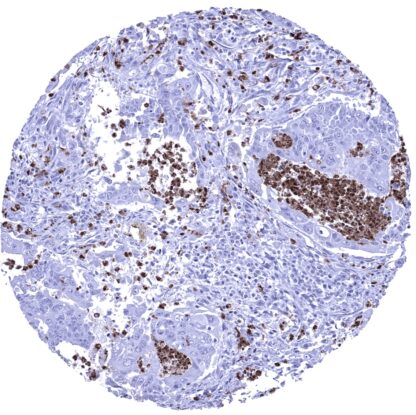
Mouse monoclonal / IgG 1:100 – 1:200 Research Use Only Intracellular, Secreted Human MSVA-812M CAAF1, CAGC, CGRP, ENRAGE, MRP6, p6 Spleen: A significant number of inflammatory cells should show a strong S100A12 immunostaining while the majority of cells remain completely negative. Colon: All epithelial and muscular cells must not show any S100A12 immunostaining. Few scattered S100A12 positive inflammatory cells can occur (mostly within blood vessels) S100A12 is a Marker for granulocytes and other “non-lymphocytic” inflammatory cells. S100A12 is a 10,5 kDa protein which is coded by the S100A12 gene at chromosome 1q21. Within granulocytes, S100A12 is co-expressed with S100A8 and S100A9 which jointly form the calprotectin heterodimer. S100A12 and S100A8/A9 proteins are all coded by neighboring genes and appear to be coregulated, to have functional similarities, and to interact with each other. S100A12 is constitutively expressed in neutrophils but can be induced in other cell types including epithelial cells. S100A12 acts as a damage-associated molecular patterns (DAMPs) protein. These are molecules released by stressed cells undergoing necrosis and act as endogenous signals to promote a proinflammatory response. Accordingly, S100A12 promotes upregulation of proinflammatory cytokines such as interleukin-1 β . S100A12 is also a ligand for the receptor for advanced glycation end products (RAGE) on monocytes or epithelial cells. S100A12 immunostaining is primarily seen in granulocytes and their precursor cells in the bone marrow. Although it cannot be excluded, that at a fraction of histiocytes/monocytes are also S100A12 positive, (at least) most of these cells do not exhibit a S100A12 immunostaining in non-inflamed normal tissues. All other normal cell types including all epithelial cells, mesenchymal tissues, and the brain also do not show S100A12 immunostaining. The findings described above are this consistent with the RNA data described in the Human Protein Atlas (Tissue expression S100A12) Positive control = Spleen: A significant number of inflammatory cells should show a strong S100A12 immunostaining while the majority of cells remain completely negative. Negative control = Colon: All epithelial and muscular cells must not show any S100A12 immunostaining. Few scattered S100A12 positive inflammatory cells can occur (mostly within blood vessels) In the bone marrow S100A12 immunostaining is seen in granuloc... S100A12 immunostaining is regularly seen in a fraction of inflammatory cells within tumors. The TCGA findings on S100A12 RNA expression in different tumor categories have been summarized in the Human Protein Atlas. These data suggest the occurrence of S100A12 expression in head and neck, urothelial, lung, cervical, stomach, and renal cancer. Squamous cell carcinoma showing multiple aggregates of S100A12 positive inflammatory cells. Invasive breast cancer of no special type (NST) showing a dense infiltrate of S100A12 positive inflammatory cells. Squamous cell carcinoma showing numerous S100A12 positive inflammatory cells in its tumor stroma. Cancer tissue gallery No data available at the moment IHC users have different preferences on how the stains should look like. Some prefer high staining intensity of the target stain and even accept some background. Others favor absolute specificity and lighter target stains. Factors that invariably lead to more intense staining include higher concentration of the antibody and visualization tools, longer incubation time, higher temperature during incubation, higher temperature and longer duration of the heat induced epitope retrieval (slide pretreatment). The impact of the pH during slide pretreatment has variable effects and depends on the antibody and the target protein. All images and data shown here and in our image galleries are obtained by the manual protocol described below. Other protocols resulting in equivalent staining are described as well. -Manual protocol Freshly cut sections should be used (less than 10 days between cutting and staining). Heat-induced antigen retrieval for 5 minutes in an autoclave at 121°C in pH 7,8 Target... A prognostic relevance of intratumoral S100A12 expression levels has been suggested for multiple tumor entities. Different S100A12 expression levels depending on the subtypes of chronic inflammatory disease have been proposed. The specific role of S100A12 in inflammatory disease needs to be further elucidated. The clinical role of the quantity of intratumoral S10A12 positive inflammatory cells is unclear. There are two ways how the specificity of antibodies can be documented for immunohistochemistry on formalin fixed tissues. These are: 1. Comparison with a second independent method for target expression measurement across a large number of different tissue types ( orthogonal strategy ), and 2. Comparison with one or several independent antibodies for the same target and showing that all positive staining results are also seen with other antibodies for the same target ( independent antibody strategy ). Orthogonal validation: For the antibody MSVA-812M specificity is suggested by the strong concordance of the immunostaining data with data from three independent RNA screening studies, including the Human Protein Atlas (HPA) RNA-seq tissue dataset, the FANTOM5 project, and the Genotype-Tissue Expression (GTEx) project, which are all summarized in the Human Protein Atlas (Tissue expression S100A12) . Immunostaining by using MSVA-812M was almost exclusively detected in organs with documented...