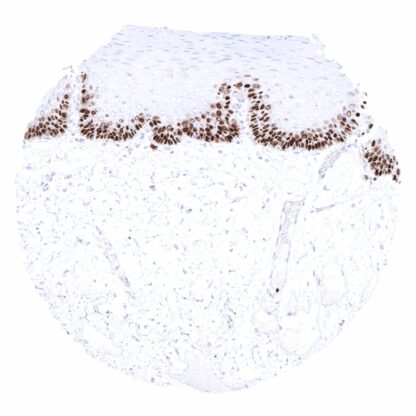
MCM3 (MSVA-503M)
Mouse monoclonal / IgG 1:100 – 1:200 Research Use Only Nuclear Human MSVA-503M Minichromosome Maintenance Complex Component 3, DNA Polymerase Alpha Holoenzyme-Associated Protein P1, DNA Replication Licensing Factor MCM3, RLF Subunit Beta, P1-MCM3, P102 Colon: A strong nuclear MCM3 immunostaining should be seen in virtually all crypt base cells. Colon: MCM3 immunostaining should be largely absent in surface epithelial cells and in most stroma cells. MCM3 is a highly sensitive marker for proliferating cells. The MCM3 gene is located at 6p12.2 and codes for a 91kDa protein which belongs to the highly conserved mini-chromosome maintenance proteins (MCM) 2-7 that play a key role in genome replication. They form a ring-shaped hexameric protein complex which is essential for the pre-replication complex and may be involved in the formation of replication forks, the recruitment of other DNA replication related proteins, and in maintaining genome integrity. MCM3 is acetylated by the chromatin-associated acetyltransferase MCM3AP. The acetylation of MCM3 inhibits the initiation of DNA replication and cell cycle progression. The MCM proteins are expressed in all cells in the G1, S, G2 and M-phase of the cell cycle but in contrast to the better established proliferation marker Ki-67, MCMs are already expressed in early G1 phase. This results in the detection of more proliferating cells as compared to Ki67 immunohistochemistry which might be advantageous in tumor types with low proliferative activity. A nuclear MCM3 immunostaining of variable intensity – mostly strong – occurs in the cell compartments of tissues known to contain proliferating cells. This includes suprabasal and (weaker) basal cell layers of squamous epithelium and urothelium, mucous neck cells of the stomach, crypts of the intestine, as well as a fraction of epithelial cells of the gallbladder, respiratory epithelium and the fallopian tube. In the endometrium, almost all epithelial cells and many stromal cells are MCM3 positive but the rate of positive cells drops in the secretion phase. Among lymphatic organs, a particularly strong MCM3 positivity occurs in most cells of germinal centres and the thymic cortex, and also in scattered individual lymphocytes while a large fraction of lymphocytes shows at least a weak MCM3 staining. Almost all cells of the bone marrow are positive. In the testis, most spermatocytes are positive but mature sperms and probably also spermatogonia are negative. In the placenta, many cells o... A nuclear MCM3 immunostaining in a fraction of tumor cells is always seen in cancerous tissues. The TCGA findings on MCM3 RNA expression in different tumor categories have been summarized in the Human Protein Atlas. Clear cell renal cell carcinoma containing few MCM3 positive tumor cells. Ductal adenocarcinoma with strong MCM3 staining of almost all tumor cells while adjacent normal duct cells are mostly negative. Basal cell carcinoma showing MCM3 positivity in a large fraction of tumor cells, predominantly in the basal layers. Cancer tissue gallery No data available at the moment IHC users have different preferences on how the stains should look like. Some prefer high staining intensity of the target stain and even accept some background. Others favor absolute specificity and lighter target stains. Factors that invariably lead to more intense staining include higher concentration of the antibody and visualization tools, longer incubation time, higher temperature during incubation, higher temperature and longer duration of the heat induced epitope retrieval (slide pretreatment). The impact of the pH during slide pretreatment has variable effects and depends on the antibody and the target protein. All images and data shown here and in our image galleries are obtained by the manual protocol described below. Other protocols resulting in equivalent staining are described as well. Manual protocol Freshly cut sections should be used (less than 10 days between cutting and staining). Heat-induced antigen retrieval for 5 minutes in an autoclave at 121°C in pH 7,8 Target ... Marker for proliferative cells. The prognostic role of the percentage of MCM7 positive cells is yet unknown for most tumor entities. It is unclear whether MCM7 quantification is equally or better suited than the established Ki67-LI for prognosis assessment. In principle, there are two ways how the specificity of antibodies can be documented for immunohistochemistry on formalin fixed tissues. These are: 1. Comparison with a second independent method for target expression measurement across a large number of different tissue types ( orthogonal strategy ), and 2. Comparison with one or several independent antibodies for the same target and showing that all positive staining results are also seen with other antibodies for the same target ( independent antibody strategy ). For proteins such as MCM3 which are expressed in virtually all tissues but restricted to specific cell types and cell compartments, orthogonal validation is not well suited. However, the comparison of MSVA-503M immunostaining data with data from three independent RNA screening studies, including the Human Protein Atlas (HPA) RNA-seq tissue dataset, the FANTOM5 project, and the Genotype-Tissue Expression (GTEx) project, which are all summarized in the Human Protein Atlas (Tis...