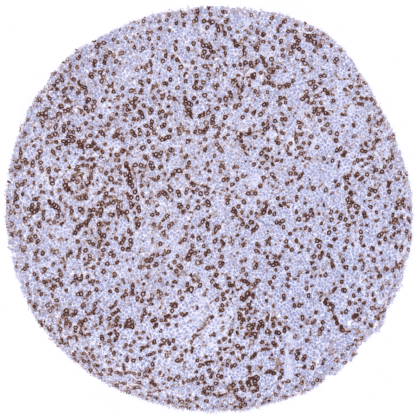
CD4 (MSVA-004R)
Recombinant Rabbit monoclonal / IgG 1:100 – 1:200 Research Use Only Cell surface Human MSVA-004R L3T4; Leu3; Ly-4; Lymphocyte antigen CD4; p55; T cell antigen T4/LEU3; T cell differentiation antigen L3T4; T-cell surface antigen T4/Leu-3; T-cell surface glycoprotein CD4 Tonsil: A moderate to strong membranous CD4 immunostaining should be seen in a subset of T-lymphocytes which is predominantly located in the interfollicular area.Macrophages in the germinal centres should show a moderate CD4 positivity. Liver: Kupffer cells and endothelial cells in the liver sinusoids must show at least a moderate CD4 staining. Tonsil: B-cells and epithelial cells must not show any CD4 staining.Liver: Hepatocytes must not show any CD4 staining. CD4 is expressed on T helper lymphocytes. CD4 (cluster of differentiation 4; leu-3) is a glycoprotein belonging to the immunoglobulin superfamily which is present on the surface of T helper cells, monocytes, macrophages, and dendritic cells. CD4+ T helper cells are an essential part of the human immune system. One of their main roles is to send signals to other types of immune cells, including CD8 killer cells, which then destroy the infectious particle. CD4 has four immunoglobulin domains (D1 to D4) that are exposed on the extracellular surface of the cell: D1 and D3 resemble immunoglobulin variable (IgV) domains. D2 and D4 resemble immunoglobulin constant (IgC) domains. CD4 interacts through its D1 domain with the β2-domain of MHC class II molecules. T helper cells are thus specific for antigens presented by MHC II and not by MHC class I (MHC class II-restricted). CD4 is a co-receptor of the T cell receptor (TCR) and assists the latter in communicating with antigen-presenting cells. The TCR complex and CD4 bind to distinct r... CD4 immunostaining is seen in >90% of thymocytes and in a large subset of extrathymic T-lymphocytes which – at variable numbers – can be found in almost every organ/tissue. At a lower level CD4 expression is also seen in monocytes and macrophages. A moderate to strong staining is seen in Langerhans cells of the skin and non-keratinizing squamous epithelium of various sites. Endothelial CD4 positivity is seen at moderate intensity in liver sinusoids and at a lower level also in some small vessels of the adrenal gland and the adenohypophysis. A moderate to strong membranous CD4 positivity is seen in all epithelial cells of the parathyroid gland. A weak CD4 staining can be seen in some littoral cells of the spleen. These findings are largely consistent with RNA and protein data summarized in the Human Protein Atlas (Tissue expression CD4) . Suggested positive tissue control : Tonsil: A moderate to strong membranous CD4 immunostaining should be seen in a subset of T-lymphocytes which is pr... Most mature T-cell lymphomas are CD4 positive, while precursor T-lymphoblastic lymphomas show variable CD4 expression. CD4 is also expressed in histiocytic sarcomas and Langerhans cell histiocytosis. Several rare T-cell lymphomas are CD4 negative such as extranodal NK/T-cell lymphomas, NK-cell leukaemia, hepatosplenic T-cell lymphoma, subcutaneous panniculitis-like T-cell lymphoma, and enteropathy-type T-cell lymphoma. Non-neoplastic CD4 positive t-cells and macrophages are commonly seen in variable numbers in tumors of all kinds. The TCGA findings on CD4 RNA expression in different tumor categories have been summarized in the Human Protein Atlas. B-CLL containing CD4 positive lymphocytes. Large cell anaplastic T-cell lymphoma showing intense CD4 immunostaining of tumor cells. Dense infiltrate of CD4 positive macrophages and lymphocytes in a Hodgkin‘s Lymphoma. Cancer tissue gallery No data available at the moment IHC users have different preferences on how the stains should look like. Some prefer high staining intensity of the target stain and even accept some background. Others favor absolute specificity and lighter target stains. Factors that invariably lead to more intense staining include higher concentration of the antibody and visualization tools, longer incubation time, higher temperature during incubation, higher temperature and longer duration of the heat induced epitope retrieval (slide pretreatment). The impact of the pH during slide pretreatment has variable effects and depends on the antibody and the target protein. Accordingly, multiple different protocols can generate identical staining results. All images and data shown here and in our image galleries are obtained by the manual protocol described below. Other protocols resulting in equivalent staining are described as well. -Manual protocol Freshly cut sections should be used (less than 10 days between cutting and staining). Hea... CD4 positive cells play a major but not yet fully understood role in inflammation and cancer. CD4 is a key component of multicolor assays analyzing the role of lymphocyte subsets in cancers and other diseases. The prevalence of a positive CD3 immunostaining in hematological and non-hematological neoplasms should be further evaluated. Specificity of MSVA-004R is documented by strong positive staining in cell types that are well documented to express CD4 such as T-lymphocytes, macrophages and liver sinusoids in combination with absence of staining in all tissues known to not express CD4 such as all epithelial tissues including those being notorious for non-specific IHC background (kidney, colonic mucosa, stomach glands). Normal tissue gallery