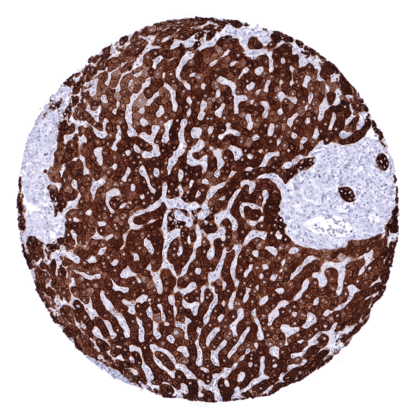
Cytokeratin, Pan (MSVA-000R)
Recombinant Rabbit monoclonal / IgG 1:100 – 1:200 Research Use Only Cytoplasmic Human MSVA-000R K1B; KRT1B; Keratin, type II cytoskeletal 1b; K77; CK-1B; Keratin 1B; Keratin-77; Cytokeratin-1B; Type-II Keratin Kb39 Liver: A strong staining of all bile duct epithelial cells and an at least moderate, predominantly membranous staining of most hepatocytes should be seen. Tonsil: All lymphocytes must not stain. However, interstitial reticulum cells with dendritic/reticular pattern show a weak to moderate fibrillar staining. Pan-cytokeratin (CKpan) is an antibody cocktail to be used for staining as many as possible cells of epithelial origin. “Pan-cytokeratin” (CKpan) is an antibody cocktail that contains most known cytokeratins and thus binds to almost all human epithelial and mesothelial cells. CKpan cocktails are broadly used in diagnostic immunohistochemistry for securing the epithelial nature of cells with equivocal morphology and visualization of cancer cells that are difficult to see in routine stains in pathology. “Pan Cytokeratin” staining pattern in Normal Tissues with antibody MSVA-000R (images are shown in our “Normal Tissue Gallery”) Brain Cerebrum Negative. Cerebellum Negative. Endocrine Tissues Thyroid Strong CKpan positivity of all epithelial cells. Parathyroid Strong CKpan positivity of all epithelial cells. Adrenal gland Weak to moderate staining of only a fraction of cells which are typically grouped together. Pituitary gland Strong CKpan positivity of all epithelial cells of the adenohypophysis. Respiratory system Respiratory epithelium Strong CKpan positivity of all epithelial cells. Lung “Only” moderate to strong staining in pneumocytes. Gastrointestinal Tract Salivary glands Strong CKpan positivity of all epithelial cells. Esophagus Strong CKpan positivity of all epithelial cells. Stomach Strong CKpan positivity of all epithelial cells. Duodenum Strong CKpan positivity of all epithelial cells. Small intestine Strong CKpan positivity of all epithelial cells. Appendix Strong CKpan p... CKpan staining is observed in the vast majority of epithelial cancers. However, CKpan staining can be absent in a fraction of epithelial tumors. For most epithelial tumor types the rate of CKpan negativity is low (0,5-5%). Particularly high rates of CKpan negativity are seen in renal cell carcinoma, hepatocellular carcinoma, and adrenal cortical neoplasms. Although CKpan staining is normally absent in non-epithelial tumors, a small fraction of sarcomas do express cytokeratins. Strong diffuse CKpan immunostaining in a pancreatic adenocarcinoma. Anaplastic thyroid cancer with strong CKpan immunostaining. Sarcoma NOS with strong CKpan immunostaining. Cancer tissue gallery Cytokeratin, Pan (MSVA-000R) publication summary Relevant publication: Menz et al.: “Pan-keratin Immunostaining in Human Tumors: A Tissue Microarray Study of 15,940 Tumors.” Published in International Journal of Surgical Pathology August 9th Epub ahead of print. PMID: 35946088. A total of 13’501 tumors from 121 different tumor categories were successfully analyzed for cytokeratin (pan) expression by using the following protocol: Heat-induced antigen retrieval for 5 minutes in an autoclave at 121°C in pH 9 Target Retrieval Solution buffer. MSVA-000R at a dilution of 1:150 at 37°C for 60 minutes. Visualization of bound antibody by the EnVision Kit (Dako, Agilent). This protocol was also used for all CKpan immunostainings depicted in our tumor and normal tissue galleries. At least one case with a positive CKpan immunostaining was seen 101 of 121 (84%) different tumor categories. Among 75 epithelial tumor entities, the CKpan positivity rate was 100% in 50 (67%) and 98-99.9% in 12 categori... IHC users have different preferences on how the stains should look like. Some prefer high staining intensity of the target stain and even accept some background. Others favor absolute specificity and lighter target stains. Factors that invariably lead to more intense staining include higher concentration of the antibody and visualization tools, longer incubation time, higher temperature during incubation, higher temperature and longer duration of the heat induced epitope retrieval (slide pretreatment). The impact of the pH during slide pretreatment has variable effects and depends on the antibody and the target protein. All images and data shown here and in our image galleries are obtained by the manual protocol described below. Protocols resulting in equivalent staining by using an automated immunostainer are described as well. Manual protocol Freshly cut sections should be used (less than 10 days between cutting and staining). Heat-induced antigen retrieval for 5 minutes in an autocl... In suitable tissues CKpan can be used for the distinction of cancerous from non-cancerous cells and can thus be employed in various experimental multicolor immunofluorescence approaches (For example: automated assessment of the Ki67 labeling index in cancer cells) Specificity of MSVA-000R is documented by strong staining in all epithelial cell types that are well documented to express cytokeratins and absence of staining in all tissues known to not express cytokeratins Normal tissue gallery