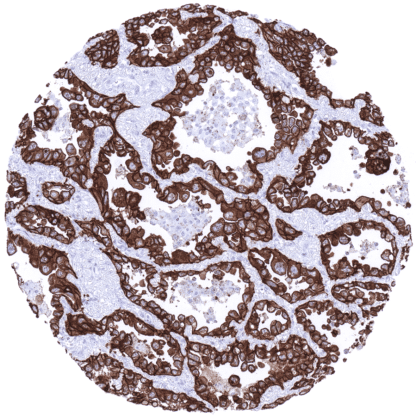
EpCAM (MSVA-326R)
Recombinant Rabbit monoclonal / IgG 1:100-200 Research Use Only Cell Surface & Cytoplasmic Human MSVA-326R Adenocarcinoma-associated Antigen; Cell Surface Glycoprotein Trop-1; EGP2; EGP314; EGP40; Epithelial Cell Adhesion Molecule; Epithelial Glycoprotein 314; ESA; KSA; TACD1; TROP1; Tumor-associated Calcium Signal Transducer 1 (TACSTD1); ECS-1; Epidermal Surface Antigen 1; ESA1; FLOT2; Flotillin-2; Membrane Component, Chromosome 17, Surface Marker-1 (M17S1); REG-1; Reggie-1; Reggie-2 Kidney: In kidney, distal tubule cells must show a strong predominantly membranous staining, while at a least moderate predominantly basolateral staining must be seen in the majority of proximal tubules cells and in scattered epithelial cells lining the Bowman capsule. Tonsil: EpCAM staining should be absent in lymphocytes or smooth muscle cells of the vessels. EpCAM is expressed in a broad range of normal and neoplastic epithelial cells. Epithelial cell adhesion molecule (EpCAM) is a glycosylated, 30-40-kDa transmembrane glycoprotein coded by a gene at 2p21. It was initially considered a cell adhesion molecule but has only weak cell-adhesive properties, It is involved in cell signaling and may thus play a role in migration, proliferation, differentiation, and epithelial-mesenchymal transformation. EpCAM signaling is partly due to protein cleavage by regulated intramembrane proteolysis (RIP). EpCAM cleavage results in the release of the extracellular domain (EpEX) into the area surrounding the cell, and of the intracellular domain (EpICD) into the cytoplasm of the cell. EpICD forms a complex with the proteins β-catenin, FHL2, and Lef inside the nucleus which then binds to DNA and promotes the transcription of c-myc, cyclins A & E, and other genes. The release of cleaved EpEX can stimulate the cleavage of additional EpCAM molecules resulting in a positive feedback loop. Active proliferation in a number of epithelial tiss... In squamous epithelia, EpCAM is variably expressed. If present, EpCAM is most strongly expressed in basal cell layers and expression can expand up to the upper third. Some squamous epithelia show few scattered EpCAM positive cells of upper layers. In the skin, EpCAM is expressed in peripheral germinative cells of sebaceous glands, ekkrine gland+, and in root sheaths of hair follicles++. Urothelium stains strongly, but sometimes weaker in umbrella cells. Scattered epithelial cells in tonsil crypts show a strong staining. Most thymus epithelial cells including corpuscles of Hassall’s weak show a weak to moderate EpCAM positivity. EpCAM is strongly expressed in all epithelial cells of the gastrointestinal tract (except parietal cells of the stomach which show a weaker staining limited to the basolateral membranes), all epithelial cells of the gallbladder and bile ducts of the liver, pancreas, salivary glands, Brunner glands, prostate, seminal vesicle, epididymis, respiratory epithelium, l... EpCAM staining occurs in most epithelial tumors. Tumors that are usually EpCAM negative include hepatocellular carcinoma and adrenocortical tumors. Tumors that are EpCAM negative in a large fraction of cases include squamous cell carcinomas and epitheloid mesotheliomas. Mesenchymal tumors and tumor components are almost always EpCAM negative. The TCGA findings on EpCAM RNA expression in different tumor categories have been summarized in the Human Protein Atlas. Colorectal adenocarcinoma with strong EpCAM immunostaining of tumor cells. Esophageal adenocarcinoma with strong EpCAM immunostaining of tumor cells. Small cell carcinoma of the lung with strong EpCAM immunostaining of tumor cells. Cancer tissue gallery EpCAM (MSVA-326R) publication summary Relevant publication: Menz et al. “Epithelial Cell Adhesion Molecule (EpCAM) Expression in Human Tumors: A Comparison with Pan-Cytokeratinand TROP2 in 14,832 Tumors” Published in Diagnostics (Basel) 2024 May; 14(10): 1044. PMID: 38786342 A total of 12,780 tumors from 120 different tumor categories were successfully analyzed by using the following protocol: Heat-induced antigen retrieval for 5 minutes in an autoclave at 121°C in pH 9,0 Target Retrieval Solution buffer. MSVA-326R, at a dilution of 1:150 at 37°C for 60 minutes. Visualization of bound antibody by the EnVision Kit (Dako, Agilent). This protocol was also used for all stainings depicted in our tumor and normal tissue galleries. Overall, 99 of 120 tumor categories showed detectable EpCAM staining with 85 tumor categories showing at least one strongly positive case. EpCAM positivity predominated in (but was not restricted to) epithelial tumors. The positivity rate was highest in adenocarcin... IHC users have different preferences on how the stains should look like. Some prefer high staining intensity of the target stain and even accept some background. Others favor absolute specificity and lighter target stains. Factors that invariably lead to more intense staining include higher concentration of the antibody and visualization tools, longer incubation time, higher temperature during incubation, higher temperature and longer duration of the heat induced epitope retrieval (slide pretreatment). The impact of the pH during slide pretreatment has variable effects and depends on the antibody and the target protein. All images and data shown here and in our image galleries are obtained by the manual protocol described below. Other protocols resulting in equivalent staining are described as well. Manual protocol Freshly cut sections should be used (less than 10 days between cutting and staining). Heat-induced antigen retrieval for 5 minutes in an autoclave at 121°C in pH 7,8 Target ... Because of partly controversial data, the diagnostic utility of EpCam IHC should be investigated in a large cohort of tumors from different entities. Although the EpCam protein is known for a long time, its function is not completely understood. Multicolor immunohistochemistry could shed some light on EpCAM signaling effects. Whether or not EpCAM expression levels influence cancer prognosis is unclear The data demonstrated on this homepage on the expression pattern of EpCAM in normal tissues largely matches the data presented on the Human Protein Atlas (Tissue expression EpCAM) although some RNA expression data derived three independent RNA screening studies, including the Human Protein Atlas (HPA) RNA-seq tissue dataset, the FANTOM5 project, and the Genotype-Tissue Expression (GTEx) project do not suggest a major EpCAM expression in several tissues where we see strong EpCAM staining. These especially include organs of the female genital tract. Positively staining epithelial structures in these tissues may constitute too small subsets of the total amount of cells to be properly represented in RNA analyses. The protein data described in the protein atlas are in better agreement with our findings but the sensitivity of the protein atlas assays has been designed to be lower than for our recommended protocol for MSVA-326R. Normal tissue gallery