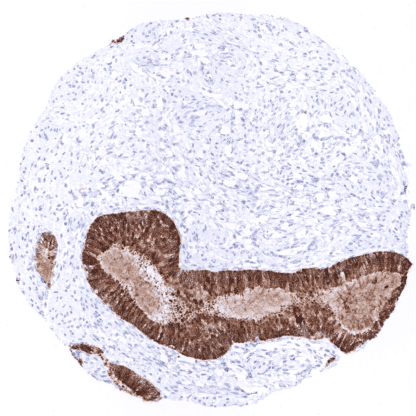
Mammaglobin (MSVA-457R)
Recombinant Rabbit monoclonal / IgG, Rabbit 1:100 – 1:200 Research Use Only Cytoplasmic Human MSVA-457R Hematopoietic Progenitor Cell Antigen, HPCA1, Mucosialin Cervix uteri: a moderate to strong cytoplasmic staining of the endocervical glands should be seen while the squamous epithelium of the ektocervix remains negative. Colon: All cells should not show any staining. Human Mammaglobin-A (SCGB2A2) was described as one of more than 20 members of the uteroglobin/Clara cell protein family of small epithelial secretory proteins, termed secretoglobins. It is a 93-amino acid protein that occurs in the mammary tissue in two main forms with approximate molecular masses of 18 and 25 kDa. Although the secretoglobins are known to be regulated by steroid hormones, mammaglobin expression in the mammary gland is independent of steroid hormones. The function of mammaglobin protein is not known. Other related secretoglobins seem to be involved in cell signaling, immune response, and chemotaxis, and may also serve as transporters for steroid hormones in humans. Mammaglobin is upregulated in neoplastic breast epithelia as compared to normal cells but its overexpression does not influence tumor cell growth. The protein’s capability to bind steroid-like molecules suggests the existence of a hormonal transport or activation function. Human Mammaglobin-A (SCGB2A2) was described as one of more than 20 members of the uteroglobin/Clara cell protein family of small epithelial secretory proteins, termed secretoglobins. It is a 93-amino acid protein that occurs in the mammary tissue in two main forms with approximate molecular masses of 18 and 25 kDa. Although the secretoglobins are known to be regulated by steroid hormones, mammaglobin expression in the mammary gland is independent of steroid hormones. The function of mammaglobin protein is not known. Other related secretoglobins seem to be involved in cell signaling, immune response, and chemotaxis, and may also serve as transporters for steroid hormones in humans. Mammaglobin is upregulated in neoplastic breast epithelia as compared to normal cells but its overexpression does not influence tumor cell growth. The protein’s capability to bind steroid-like molecules suggests the existence of a hormonal transport or activation function. The mammaglobin protein is detectable in only a few normal tissue types including luminal cells of the breast (not always in all cells; + to +++), endocervical glands (mostly +++, but not all glands in all patients), endometrium (not always in all cells; + to +++), scattered epithelial cells in the fallopian tube (++), principal cells of the epididymis (+ to ++), and few scattered cells in salivary glands (+ – ++). Mammaglobin staining is most intense in endocervical and endometrial glands. In these tissues, the stroma cells are sometimes also positive (perhaps representing a diffusion artifact). These findings are largely consistent with RNA and protein data described in the Human Protein Atlas (Tissue expression Mammaglobin) . The protein atlas data are expanded by demonstration of scattered positive cells in the fallopian tube and in salivary glands . The latter is visible in one image depicted in the Human Protein Atlas but was not described. Suggested positive tissue control: Cerv... Mammaglobin occurs in about 80% of breast carcinomas. Among non–breast carcinomas, convincing mammaglobin expression is seen in endometrioid carcinomas (~40% cases) and sweat and salivary gland tumors. Up to 15% of other non breast carcinomas (such as stomach, lung, colon, hepatobiliary, thyroid, ovarian, and urothelial carcinomas) have been reported positive, but expression was usually only focally. The TCGA findings on Mammaglobin RNA expression in different tumor categories have been summarized in the Human Protein Atlas. Endometroid ovarian carcinoma with strong mammaglobin immunostaining Endometroid endometrium carcinoma with strong mammaglobin positivity Strong mammaglobin immunostaining in all cells of a lobular breast cancer Cancer tissue gallery Mammaglobin-A (MSVA-457R) publication summary Relevant publication: Gorbokon et al. “Mammaglobin-A Expression Is Highly Specific for Tumors Derived from the Breast, the Female Genital Tract, and the Salivary Gland” Published in Diagnostics (Basel). 2023 Mar 22;13(6):1202. doi: 10.3390/diagnostics13061202. PMID: 36980510 A total of 14,232 tumors from 128 different tumor categories were successfully analyzed by using the following protocol: Heat-induced antigen retrieval for 5 minutes in an autoclave at 121°C in pH 9,0 Target Retrieval Solution buffer. MSVA-457R, at a dilution of 1:150 at 37°C for 60 minutes. Visualization of bound antibody by the EnVision Kit (Dako, Agilent). This protocol was also used for all stainings depicted in our tumor and normal tissue galleries. Overall, 37 of 128 tumor categories showed detectable mammaglobin-A staining with 26 tumor categories showing at least one strongly positive case. 1437 of 1450 (99%) mammaglobin-A-positive tumors were derived from four ... IHC users have different preferences on how the stains should look like. Some prefer high staining intensity of the target stain and even accept some background. Others favor absolute specificity and lighter target stains. Factors that invariably lead to more intense staining include higher concentration of the antibody and visualization tools, longer incubation time, higher temperature during incubation, higher temperature and longer duration of the heat induced epitope retrieval (slide pretreatment). The impact of the pH during slide pretreatment has variable effects and depends on the antibody and the target protein. Accordingly, multiple different protocols can generate identical staining results. All images and data shown here and in in our image galleries are obtained by the manual protocol described below. Other protocols resulting in equivalent staining are described as well. Manual protocol Freshly cut sections should be used (less than 10 days between cutting and staining). H... A comprehensive study analyzing mammaglobin-A in various different tumor entities would be helpful to better assess the diagnostic significance of mammaglobin IHC. The clinical significance of mammaglobin-A expression levels in breast cancer and other tumor types is not clear yet. The diagnostic accuracy of mammaglobin-A IHC in combination with other antibodies such as GATA3 and gcdfp-15 awaits further evaluation. The functional role of mammaglobin in normal and neoplastic cells is unknown. Specificity and sensitivity of MSVA-457R is documented by strong positive staining in cell types that are well documented to express Mammaglobin such as breast, endometrium and endocervical glands in combination with the complete absence of staining in tissues that are not expected to express the protein (see normal tissue gallery). Immunostaining was also absent in tissues notorious for non-specific IHC background such as kidney, colonic mucosa, and epidermis. Normal tissue gallery