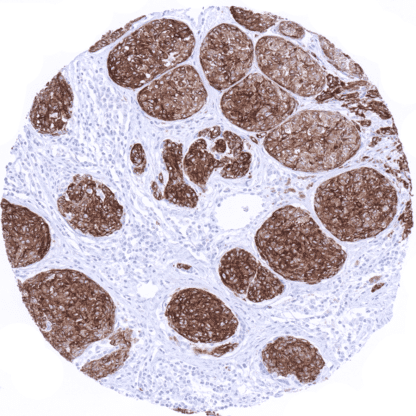
Melan A+ (MSVA-901M+)
Recombinant Mouse monoclonal / IgG 1:50 – 1:100 Research Use Only Cytoplasmic Human MSVA-901M+ Antigen LB39-AA, Antigen SK29-AA, Melanoma antigen recognized by T-cells 1, MLAN-A, MLANA Skin: Virtually all melanocytes should show a strong Melan A+ immunostaining including a weak to moderate staining in melanocytic dendrites. Adrenal gland: An at least moderate Melan A+ immunostaining should be seen in adrenocortical cells. Kidney: Melan A+ immunostaining should be absent in all cells. Adrenal gland: Melan A+ immunostaining should be absent in all medullary cells. Melan A+ is a marker for melanoma, adrenocortical and other tumors. The Melan A (melanocyte antigen) protein, also termed “melanoma antigen recognized by T cells 1” (MART-1) is coded by a gene on chromosome 9p24.1. The 18 kDa protein has a single transmembrane domain and consists of 118 amino acids. The function of the protein is unknown. A small fragment of the protein (about nine amino acids) is bound by MHC class I complexes and presented to cytotoxic T cells. The MART-1/melan A antigen is specific for the melanocyte lineage, found in normal skin, the retina, and melanocytes, but not in other normal tissues. As few other Melan-A antibodies, MSVA-901M+ (Melan-A+) not only recognizes the Melan A protein but – as a result of a cross-reactivity – also an unknown structure related to corticosteroids. Therefore, Melan A+ also recognizes adrenocortical cells and a few other tissues. Melan A+ is thus useful as a marker for benign and malignant melanocytic tumors as well as for various steroid producing tissues. Using the antibody MSVA-901M+ (Melan A+), a strong staining can be observed in melanocytes in skin and non-keratinizing squamous epithelia from various sites. Adrenocortical cells, and a variable fraction of epithelial cells in the adenohypophysis also show a moderate to strong Melan A+ immunostaining. A moderate intensity staining is present in theca interna cells of ovary and in testicular Leydig cells. Moreover, a faint immunostaining is detectable at the apical membranes of ciliated cells of respiratory epithelium. These findings are not fully comparable to the RNA and protein data summarized in the Human Protein Atlas (Tissue expression Melan A) but in part consistent with protein data of the protein atlas. It is of note, that the different antibodies developed within the protein atlas project contain antibodies of the Melan-A+ type showing strong immunostaining of adrenocortical cells ( CAB000057 ) und others that do not stain adrenal tissue ( HPA048662 ) Suggested positive tis... A Melan A+ staining is seen in the vast majority of primary malignant melanomas, all types of cutaneous naevi, and in other tumors of melanocytic differentiation, such as clear cell sarcoma, melanotic neurofibroma, melanotic schwannoma as well as PEComas (perivascular epitheloid cell tumor) including angiomyolipoma, lymphangioleiomyoma(-tosis), and pulmonary sugar tumor. Melan A+ staining is sometimes reduced and/or only patchy in nature in desmoplastic melanoma and in metastatic melanomas. MSVA-900M+ (Melan A+) belongs to a subgroup of “Melan A” antibodies that share a diagnostically useful cross-reactivity with a structure linked to steroid hormones. This results in a strong Melan A+ immunostaining of adrenocortical adenomas and carcinomas, sex cord-stromal tumors of the ovary, Leydig cell tumor of the testis as well as individual tumors of various other entities. These tumor entities are, however, not recognized by several other – more specific -Melan-A antibodies. The TCGA findings... No data available at the moment IHC users have different preferences on how the stains should look like. Some prefer high staining intensity of the target stain and even accept some background. Others favor absolute specificity and lighter target stains. Factors that invariably lead to more intense staining include higher concentration of the antibody and visualization tools, longer incubation time, higher temperature during incubation, higher temperature and longer duration of the heat induced epitope retrieval (slide pretreatment). The impact of the pH during slide pretreatment has variable effects and depends on the antibody and the target protein. Accordingly, multiple different protocols can generate identical staining results. All images and data shown here and in our image galleries are obtained by the manual protocol described below. Other protocols resulting in equivalent staining are described as well. Manual protocol Freshly cut sections should be used (less than 10 days between cutting and staining). Heat... The exact function of Melan A is unknown. The utility of Melan A as a cancer vaccine target is under investigation. Using the antibody MSVA-901M+ (Melan A+), a strong staining can be observed in melanocytes in skin and non-keratinizing squamous epithelia from various sites. Adrenocortical cells, and in a variable fraction of epithelial cells in the adenohypophysis. A moderate intensity staining is present in theca interna cells of ovary and in testicular Leydig cells. Moreover, a faint immunostaining is detectable at the apical membranes of ciliated cells of respiratory epithelium. These findings are not fully comparable to the RNA and protein data summarized in the Human Protein Atlas (Tissue expression Melan A) but in part consistent with protein data of the protein atlas. It is of note, that the different antibodies developed within the protein atlas project contain antibodies of the Melan-A+ type showing strong immunostaining of adrenocortical cells ( CAB000057 ) und others that do not stain adrenal tissue ( HPA048662 ). Normal tissue gallery