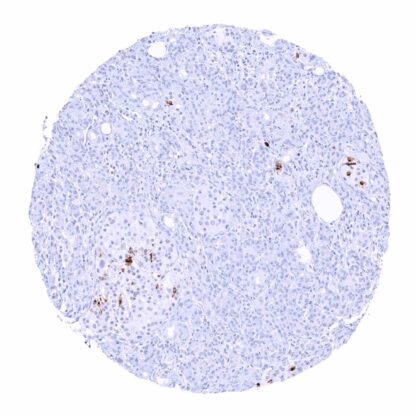
Somatostatin (MSVA-638R)
Recombinant Rabbit monoclonal / IgG 1:100 – 1:200 Research Use Only Secreted Human MSVA-638R SMST Pancreas: A subset of pancreatic islet cells should show strong somatostatin positivity. Kidney: All cells must not show somatostatin immunostaining. Somatostatin is a peptide hormone with paracrine and humoral activity. Somatostatin is a peptide hormone coded by the SST gene at chromosome 3q27.3. Somatostatin has two active forms consisting of 14 and 28 amino acids produced by alternative cleavage of a single proprotein. These peptides exert humoral and paracrine functions through interaction with several somatostatin receptors. Somatostatin is secreted by delta cells in the digestive system, namely the pyloric antrum, the duodenum and the pancreatic islets. In the stomach, somatostatin antagonizes the stimulatory effect of histamine to reduce acid secretion by paracrine effects on acid-producing parietal cells. In the brain, somatostatin is produced by neuroendocrine neurons of the ventromedial nucleus of the hypothalamus. Somatostatin is then carried to the anterior pituitary gland, where it inhibits the secretion of growth hormone. Somatostatin is also produced by populations of neuroendocrine neurons in other regions of the brain. Somatostatin is an inhibitory hormone that in the anterior pituitar... Images describing the somatostatin staining pattern in normal tissues obtained by the antibody MSVA-638R are shown in our “Normal Tissue Gallery”. Brain Cerebrum Few neuroendocrine neurons may show somatostatin positivity in specific regions of the brain. Cerebellum Few neuroendocrine neurons may show somatostatin positivity in specific regions of the brain. Endocrine Tissues Thyroid Negative. Parathyroid Negative. Adrenal gland A subset of cells shows somatostatin positivity of variable intensity. Pituitary gland Negative. Respiratory system Respiratory epithelium Negative. Lung Negative. Gastrointestinal Tract Salivary glands Negative. Esophagus Negative. Stomach Distinct somatostatin staining of scattered neuroendocrine (delta) cells. Duodenum Distinct somatostatin staining of scattered neuroendocrine (delta) cells. Small intestine Distinct somatostatin staining of scattered neuroendocrine (delta) cells. Appendix Distinct somatostatin staining of scattered neuroendocrine (delta) cel... A positive somatostatin immunostaining can be seen in a fraction of neuroendocrine tumors (in particular if these are derived from the pancreas), a fraction of pheochromocytomas and rarely also in other tumors. The TCGA findings on Somatostatin RNA expression in different tumor categories have been summarized in the Human Protein Atlas. Pheochromocytoma with strong somatostatin immunostaining of tumor cells Clear cell renal cell carcinoma with strong somatostatin immunostaining of tumor cells Neuroendocrine tumor with strong somatostatin immunostaining of tumor cells. (2) Cancer tissue gallery No data available at the moment IHC users have different preferences on how the stains should look like. Some prefer high staining intensity of the target stain and even accept some background. Others favor absolute specificity and lighter target stains. Factors that invariably lead to more intense staining include higher concentration of the antibody and visualization tools, longer incubation time, higher temperature during incubation, higher temperature and longer duration of the heat induced epitope retrieval (slide pretreatment). The impact of the pH during slide pretreatment has variable effects and depends on the antibody and the target protein. All images and data shown here and in our image galleries are obtained by the manual protocol described below. Other protocols resulting in equivalent staining are described as well. Manual protocol Freshly cut sections should be used (less than 10 days between cutting and staining). Heat-induced antigen retrieval for 5 minutes in an autoclave at 121°C in pH 7,8 Target ... The clinical significance of somatostatin expression in cancer is unclear. There are two ways how the specificity of antibodies can be documented for immunohistochemistry on formalin fixed tissues. These are: 1. Comparison with a second independent method for target expression measurement across a large number of different tissue types (orthogonal strategy), and 2. Comparison with one or several independent antibodies for the same target and showing that all positive staining results are also seen with other antibodies for the same target (independent antibody strategy). Orthogonal validation: For the antibody MSVA-638R specificity is suggested by the complete concordance of the immunostaining data with data from three independent RNA screening studies, including the Human Protein Atlas (HPA) RNA-seq tissue dataset, the FANTOM5 project, and the Genotype-Tissue Expression (GTEx) project, which are all summarized in the Human Protein Atlas (Tissue expression Somatostatin) . Somatostatin RNA expression had only been described in organs ( adrenal gland, gastroint...