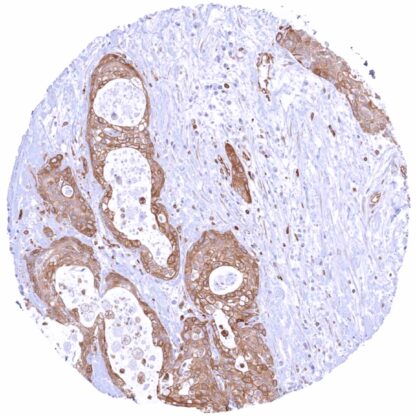
Synaptophysin (MSVA-462R)
Recombinant Rabbit monoclonal / IgG 1:100 – 1:200 Research Use Only Cytoplasmic Human MSVA-462R Major synaptic vesicle protein p38; MRX96; MRXSYP; Syn p38; Syp; SYPH Colon: A moderate to strong staining of the axons of the Auerbach’s and Meissner’s plexus should be seen while the endocrine cells of the mucosa and the peripheral nerves in the mucosa must show an at least a weak to moderate staining. Pancreas: A strong staining should be seen in islets of Langerhans and in peripheral nerve fibres located between the exocrine cells. Colon: All non-endocrine epithelial cells and lymphocytes should not show any staining. Synaptophysin is expressed in neuronal and neuroendocrine cells. Synaptophysin is a 38kDa calcium binding integral-membrane glycoprotein protein coded by the SYP gene located at Xp11.23-p11.22. It is also termed as “major synaptic vesicle protein p38” reflecting the fact that it is the most abundant synaptic vesicle membrane glycoprotein, present in neuronal presynaptic vesicles. It is present in virtually all neurons in the brain and spinal cord that participate in synaptic transmission. Because of its ubiquity at the synapse, synaptophysin quantification by immunostaining is used for quantification of synapses. Synaptophysin interacts with the essential synaptic vesicle protein synaptobrevin but its exact function is not known. Elimination of synaptophysin in mice results in behavioral changes such reduced spatial learning. Synaptophysin has been suggested to play a role in X linked intellectual disability. Synaptophysin is also regularly expressed in neuroendocrine cells and its immunohistochemical detection is thus used to diagnose neuroendocrin... Synaptophysin staining pattern in Normal Tissues with antibody MSVA-462R (images are shown in our “Normal Tissue Gallery”) Brain Cerebrum Strong synaptophysin positivity. Cerebellum Strong synaptophysin positivity. Endocrine Tissues Thyroid Strong synaptophysin positivity of T-cells.. Parathyroid Negative. Adrenal gland Strong synaptophysin positivity of all cells from the medulla. Weak to moderate synaptophysin staining can occur in a fraction of adrenocortical cells. Pituitary gland Strong synaptophysin positivity of the posterior lobe and of all epithelial cells of the anterior lobe. Respiratory system Respiratory epithelium Strong synaptophysin positivity of scattered neuroendocrine cells. Lung Negative. Gastrointestinal Tract Salivary glands Synaptophysin positivity of nerve fibres in the stroma. Epithelial cells are negative. Esophagus Variable (weak to strong) synaptophysin staining of axons and ganglion cells of the peripheral nerves in the gastrointestinal wall. Stomach Strong... Synaptophysin is typically expressed at high levels in pheochromocytoma, neuroendocrine tumors, neuroendocrine carcinomas, medullary carcinomas of the thyroid, pituitary adenomas, Merkel cell carcinomas and in small cell carcinomas irrespective of their site of origin. Synaptophysin immunostaining is also seen in various neuronal tumors such as neuroblastoma, ganglioneuroblastoma, ganglioneuroma, and ganglioglioma. Synaptophysin may also be detected in brain tumors like oligodendroglioma, astrocytoma and ependymoma, however, to a varying extent. Moreover, synaptophysin can be detected in a small fraction of various other tumor entities, such as for example breast, prostate or ovarian cancers if these tumors exhibit neuroendocrine differentiation. The TCGA findings on Synaptophysin RNA expression in different tumor categories have been summarized in the Human Protein Atlas. Pheochromocytoma with strong, diffuse synaptophysin positivity in all tumor cells. Synaptophysin negative adenocar... Synaptophysin (MSVA-462R) publication summary Relevant publication: Uhlig et al. “ Synaptophysin and chromogranin A expression analysis in human tumors ” . Published in Mol Cell Endocrinol. 2022 Sep 15;555:111726. PMID: 35921917. A total of 13’405 tumors from 120 different tumor categories were successfully analyzed by using the following protocol: Heat-induced antigen retrieval for 5 minutes in an autoclave at 121°C in pH7,8 Target Retrieval Solution buffer. MSVA-462R at a dilution of 1:150 at 37°C for 60 minutes. Visualization of bound antibody by the EnVision Kit (Dako, Agilent). This protocol was also used for all stainings depicted in our tumor and normal tissue galleries. In this study, at least one synaptophysin positive case was seen in 61 (50.8%) of 120 tumor categories and 37 (30.8%) tumor categories included at least one case with strong positivity. The highest frequencies of synaptophysin positivity (and the highest levels of expression) were seen in various types of neuroe... IHC users have different preferences on how the stains should look like. Some prefer high staining intensity of the target stain and even accept some background. Others favor absolute specificity and lighter target stains. Factors that invariably lead to more intense staining include higher concentration of the antibody and visualization tools, longer incubation time, higher temperature during incubation, higher temperature and longer duration of the heat induced epitope retrieval (slide pretreatment). The impact of the pH during slide pretreatment has variable effects and depends on the antibody and the target protein. Accordingly, multiple different protocols can generate identical staining results. All images and data shown here and in our image galleries are obtained by the manual protocol described below. Other protocols resulting in equivalent staining are described as well. Manual protocol Freshly cut sections should be used (less than 10 days between cutting and staining). Heat... The clinical significance of neuroendocrine differentiation of cancers not originating from neuroendocrine precursor cells is still not clear. This especially applies for its prognostic and therapeutic implications. Synaptophysin interacts with the essential synaptic vesicle protein synaptobrevin but its exact function is not known. Because of its ubiquity at the synapse, synaptophysin quantification by immunostaining is used for quantification of synapses. Specificity of MSVA-462R is documented by strong positive staining in cell types that are well documented to express synaptophysin such as islets of Langerhans, the adrenal medulla, and in scattered cells of the diffuse neuroendocrine system in combination with absence of staining in all tissues known to not express synaptophysin such as non-neuroendocrine epithelial cells, lymphocytes and muscle cells. Normal tissue gallery