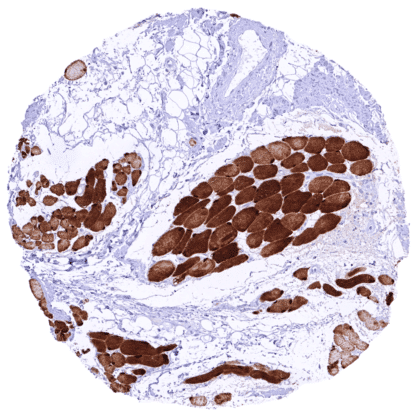
TRIM72 (HMV313)
Recombinant Rabbit monoclonal / IgG 1:100 – 1:200 Research Use Only Intracellular Human HMV313 Tripartite motif containing 72, MG53 Skeletal muscle: A strong membranous and cytoplasmic TRIM72 immunostaining should be seen in skeletal muscle cells. Tonsil: All cell types must completely lack TRIM72 staining. TRIM72 is a marker for skeletal muscle cells. Tripartite motif protein 72 (TRIM72) is one out of a family of 80 tripartite motif proteins. It is coded by the TRIM72 gene on chromosome 16p11.2 and consists of four domains: RING domain, B-box domain, coiled-coil domain, and SPRY domain. TRIM72 is predominantly expressed in skeletal muscle. Muscle cell membrane repair is believed to represent its main function but TRIM72 also has roles in calcium homeostasis, muscle contraction, vesicle trafficking, anti-inflammation, reduction of oxidative stress, and regulation of systemic insulin response. Images describing the TRIM72 staining pattern in normal tissues obtained by the antibody HMV313 are shown in our “ Normal Tissue Gallery ”. Brain Cerebrum Negative. Cerebellum A weak TRIM72 staining of fibres in the molecular layer may occur. Endocrine Tissues Thyroid Negative. Parathyroid Negative. Adrenal gland Negative. Pituitary gland Negative. Respiratory system Respiratory epithelium Negative. Lung Negative. Gastrointestinal Tract Salivary glands Weak to moderate, primarily cytoplasmic TRIM72 staining of a subset of excretory duct epithelial cells. Esophagus Negative. Stomach Negative. Duodenum Negative. Small intestine Negative. Appendix Negative. Colon Negative. Rectum Negative. Liver Negative. Gallbladder Negative. Pancreas Negative. Genitourinary Kidney TRIM72 staining of arterioles and small arteries can occur. Urothelium Negative. Male genital Prostate Negative. Seminal vesicles Negative. Testis Negative. Epididymis Negative. Female genital Breast Negative. Uterus, myometri... TRIM72 immunostaining can be often found in tumor cells with skeletal muscle differentiation. At lower frequency TRIM72 expression also occurs in various other cancer entities. The TCGA findings on TRIM72 RNA expression in different tumor categories have been summarized in the Human Protein Atlas. TRIM72 negative myxofibrosarcoma. Rhabdomyosarcoma with intense TRIM72
positivity of all tumor cells. Colorectal adenocarcinoma with moderate to
strong TRIM72 staining of a fraction of tumor
cells. Cancer tissue gallery No data available at the moment IHC users have different preferences on how the stains should look like. Some prefer high staining intensity of the target stain and even accept some background. Others favor absolute specificity and lighter target stains. Factors that invariably lead to more intense staining include higher concentration of the antibody and visualization tools, longer incubation time, higher temperature during incubation, higher temperature and longer duration of the heat induced epitope retrieval (slide pretreatment). The impact of the pH during slide pretreatment has variable effects and depends on the antibody and the target protein. All images and data shown here and in our image galleries are obtained by the manual protocol described below. Other protocols resulting in equivalent staining are described as well. Manual protocol Freshly cut sections should be used (less than 10 days between cutting and staining). Heat-induced antigen retrieval for 5 minutes in an autoclave at 121°C in pH 7,8 Target ... The function of TRIM72 in skeletal muscle is not completely understood. The role and significance of TRIM72 expression on non-skeletal muscle cancers is unclear. In principle, there are two ways how the specificity of antibodies can be documented for immunohistochemistry on formalin fixed tissues. These are: 1. Comparison with a second independent method for target expression measurement across a large number of different tissue types (orthogonal strategy), and 2. Comparison with one or several independent antibodies for the same target and showing that all positive staining results are also seen with other antibodies for the same target (independent antibody strategy). Orthogonal validation: For the antibody HMV309 specificity is suggested by the good concordance of the immunostaining data with data from three independent RNA screening studies, including the Human Protein Atlas (HPA) RNA-seq tissue dataset, the FANTOM5 project, and the Genotype-Tissue Expression (GTEx) project, which are all summarized in the Human Protein Atlas (Tissue expression TRIM72) . TRIM72 RNA expression was only described in skeletal muscle, the tissue type with – by ...