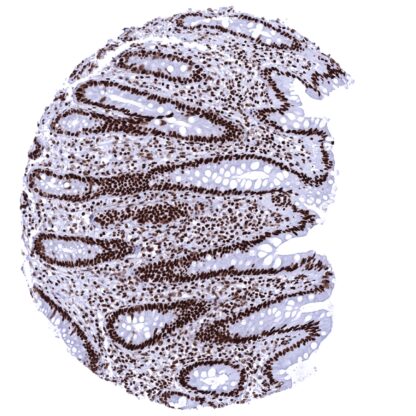
XRCC5 / Ku-80 (MSVA-880M)
Mouse monoclonal / IgG 1:100 – 1:200 Research Use Only Nucleus. Nucleoplasm. Human MSVA-880M ATP-dependent DNA helicase II 80kDa subunit; CTC box-binding factor 85kDa subunit (CTC85); CTCBF; DNA repair protein XRCC5; KARP1; Ku autoantigen 80kDa; Ku80; Ku86; KUB2; Lupus Ku autoantigen protein p86; Nuclear factor IV (NFIV); Thyroid-lupus autoantigen; TLAA; X-ray repair cross-complementing protein 5 (XRCC5) Tonsil: A strong staining should be seen in the nuclei of all cells. A tumor or a cell line with documented loss of Ku80 expression. XRCC5 is a critical gene for radiosensitivity and senescence. Ku80 is an 80 kDa protein that is coded by the XRCC5 gene on chromosome 2q35. Together with Ku70 it forms the Ku heterodimer, which binds to DNA double-strand break ends. The Ku heterodimer is essential for the non-homologous end joining (NHEJ) pathway of DNA repair and V(D)J recombination as well as for telomere length maintenance and subtelomeric gene silencing. In cancer, deletion or mutation of the Ku80 (or Ku70) genes results in a highly radiosensitive phenotype. Low function of Ku80 leads to accelerating aging. Ku80(-/-) mice exhibit early onset of senescence. The quantity of Ku80 protein varies greatly between species and is strongly linked to longevity. Ku80 acts as an autoantigen in systemic lupus erythematosus. Ku80 immunostaining occurs in virtually all nuclei of all cells in all tissues. Variations of the staining intensity are hardly discernible. A reduced level of expression is, however, seen in hepatocytes and spermatids. Cytoplasmic and/or membranous Ku80 immunostaining is not seen in any normal striated muscle, heart muscle, smooth muscle, myometrium of the uterus, corpus spongiosum of the penis, ovarian stroma, fat, skin (including hair follicle and sebaceous glands), oral mucosa of the lip, oral cavity, surface epithelium of the tonsil, and transitional mucosa of the anal canal, ectocervix, squamous epithelium of the esophagus, urothelium of the renal pelvis and urinary bladder, decidua, placental trophoblastic cells, lymph node, spleen, thymus, tonsil, mucosa of the stomach, duodenum, ileum, appendix, colon, rectum and gall bladder, pancreas, liver, parotid gland, submandibular gland, sublingual gland, Brunner gland of the duodenum, cortex and medulla of the kidney, prostate, semina... Nuclear Ku80 immunostaining is seen in the vast majority of tumors although the intensity may vary considerably between individual cases. The TCGA findings on XRCC5 RNA expression in different tumor categories have been summarized in the Human Protein Atlas. Warthin tumor depicting a strong Ku80 immunostaining of tumor cells and associated lymphocytes Malignant mesothelioma with only weak and fokal Ku80 staining of tumor cells while the staining is more intense in inflammatory cells. Merkel cell carcinoma with intense Ku80 immunostaining of all tumor cells Cancer tissue gallery No data available at the moment IHC users have different preferences on how the stains should look like. Some prefer high staining intensity of the target stain and even accept some background. Others favor absolute specificity and lighter target stains. Factors that invariably lead to more intense staining include higher concentration of the antibody and visualization tools, longer incubation time, higher temperature during incubation, higher temperature and longer duration of the heat induced epitope retrieval (slide pretreatment). The impact of the pH during slide pretreatment has variable effects and depends on the antibody and the target protein. All images and data shown here and in our image galleries are obtained by the manual protocol described below. Other protocols resulting in equivalent staining are described as well. Manual protocol Freshly cut sections should be used (less than 10 days between cutting and staining). Heat-induced antigen retrieval for 5 minutes in an autoclave at 121°C in pH 7,8 Target ... The prognostic and predictive relevance of the expression levels of Ku80 needs to be investigated. For this purpose it will be necessary to as much as possible quantitate the level of expression in individual tumors. There are two ways how the specificity of antibodies can be documented for immunohistochemistry on formalin fixed tissues. These are: 1. Comparison with a second independent method for target expression measurement across a large number of different tissue types ( orthogonal strategy ), and 2. Comparison with one or several independent antibodies for the same target and showing that all positive staining results are also seen with other antibodies for the same target ( independent antibody strategy ). Orthogonal validation is, however, not suited for validation of antibodies for proteins that are expressed in every cell of every organ. Comparison of antibodies : Specific Ku80 staining by MSVA-880M is supported by the perfect match with the expected staining pattern of a purely nuclear staining in normal tissues. This staining pattern also matches the stainings observed by the antibody HPA025813 used in the analyses described in the Human Protein Atlas (Tissue expression XRCC5) . HPA025...