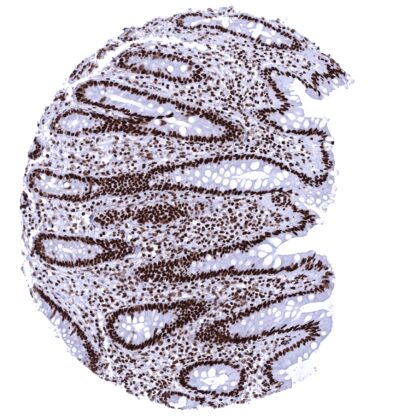
ZAP-70 (MSVA-870R)
Recombinant Rabbit monoclonal / IgG 1:100 – 1:200 Research Use Only Cell Surface and Cytoplasmic Human MSVA-870R Selective T cell defect; SRK; STD; Syk-related tyrosine kinase; Tyrosine-protein kinase ZAP-70;TZK; Zeta chain associated protein kinase 70kDa Tonsil: A large fraction of the lymphocytes in the interfollicular areas and few lymphocytes in the germinal centres should show a strong ZAP70 immunostaining. Tonsil: ZAP70 immunostaining should be absent in epithelial tissues and the majority of cells in germinal centres. ZAP-70 is a prognostic marker in B-CLL. ZAP70 (Zeta-chain-associated protein kinase 70) is a 70 kDa protein-tyrosine kinase coded by the ZAP70 gene at chromosome 2q11.2. ZAP70 is mainly expressed in T cells and NK cells and plays a role in T cell receptor (TCR) activation. Because T cell receptors do not have any own enzymatic activity, they rely on signaling molecules to convey signals from the cell membrane. ZAP70 is a critical cytoplasmic tyrosine kinase that initiates a signal pathway downstream of an activated T cell receptor. Aberrant expression of ZAP70 occurs in a subset of Chronic Lymphocytic Leukemia (CLL) and can also occur in other B-cell malignancies. In B-CLL, ZAP70 expression reflects unfavorable patient prognosis. CLL patients that are positive for the marker ZAP-70 have an average survival of 8 years. CLL patients that are negative for ZAP-70 have an average survival of more than 25 years. [1] [1] Chiorazzi et al. „Chronic Lymphocytic Leukemia” The New England Journal of Medicine: February 24, 2005 The staining of ZAP70 positive cells in normal tissues reflects the physiologic distribution of T cells, natural killer cells, and cortical thymocytes. Accordingly, ZAP70 positive cells are most prominently seen in the thymus and lymphatic organs. ZAP70 positive (T-) lymphocytes also regularly occur – at variable numbers – in most other tissue types. The findings described above are this consistent with the RNA data described in the Human Protein Atlas (Tissue expression ZAP-70) Positive control = Tonsil: A large fraction of the lymphocytes in the interfollicular areas and few lymphocytes in the germinal centres should show a strong ZAP70 immunostaining. Negative control = Tonsil: ZAP70 immunostaining should be absent in epithelial tissues and the majority of cells in germinal centres. In the appendix, numerous ZAP70 positive lymphocytes are seen. They occur within the epithelium, in the lamina propria, and – at lower numbers – within germinal centres ZAP70 positive lymphocytes are see... A positive ZAP70 immunostaining occurs in most T-cell lymphomas and a fraction of B-cell neoplasms. In addition, ZAP70 positive T-lymphocytes constitute a part of the tumor microenvironment of all kinds of neoplasms. The TCGA findings on ZAP-70 RNA expression in different tumor categories have been summarized in the Human Protein Atlas. Large cell anaplastic ALK1 positive T-cell lymphoma with moderate ZAP70 staining of tumor cells. ZAP70 staining is stronger in few interspersed normal T-lymphocytes Warthin tumor containing numerous ZAP70 positive T-lymphocytes Marginal zone lymphoma with weak ZAP70 immunostaining of tumor cells. ZAP70 staining is stronger in few interspersed normal T-lymphocytes Cancer tissue gallery No data available at the moment IHC users have different preferences on how the stains should look like. Some prefer high staining intensity of the target stain and even accept some background. Others favor absolute specificity and lighter target stains. Factors that invariably lead to more intense staining include higher concentration of the antibody and visualization tools, longer incubation time, higher temperature during incubation, higher temperature and longer duration of the heat induced epitope retrieval (slide pretreatment). The impact of the pH during slide pretreatment has variable effects and depends on the antibody and the target protein. All images and data shown here and in our image galleries are obtained by the manual protocol described below. Other protocols resulting in equivalent staining are described as well. -Manual protocol Freshly cut sections should be used (less than 10 days between cutting and staining). Heat-induced antigen retrieval for 5 minutes in an autoclave at 121°C in pH 7,8 Target... The exact function of ZAP70 in immune regulation needs further investigation. The role of ZAP70 in B-cell neoplasms is not sufficiently clear. There are two ways, how the specificity of antibodies can be documented for immunohistochemistry on formalin fixed tissues. These are: 1. Comparison with a second independent method for measuring target expression across a large number of different tissue types ( orthogonal strategy ), and 2. Comparison with one or several independent antibodies for the same target and showing that all positive staining results are also seen with other antibodies for the same target ( independent antibody strategy ). As a standard orthogonal validation process for MSVA antibodies, RNA data summarized in the Human Protein Atlas (Tissue expression ZAP-70) are used for comparison. In accordance with these RNA findings, ZAP70 positive cells strongly predominated in lymphatic tissues. However, the validity of orthogonal validation is limited for proteins that are expressed in significant subsets of lymphocytes because these cells occur in virtually all organs. The validation of MSVA-870R is, therefore, also...