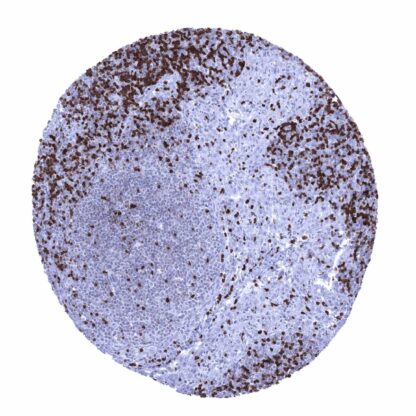
53BP1 (HMV324)
Recombinant Rabbit monoclonal / IgG 1:100 – 1:200 Research Use Only Nucleus Human HMV324 tumor protein p53 binding protein 1 , 53BP1 , TDRD30 , p202 , p53BP1 Testis: 53BP1 staining should be strong in spermatogonia but decrease with maturation of germ cells. Testis: 53BP1 staining should be absent in mature spermatocytes and spermatids. 53BP1 is a DNA damage checkpoint critical for DNA repair pathway choice. p53-binding protein 1 (53BP1) is a scaffold protein without enzymatic activity which is encoded by the TP53BP1 gene at chromosome 15q15.3. 53BP1 participates in DNA damage checkpoint control and DNA repair, and acts as a key determinant of DNA double-strand break (DSB) repair pathway choice. The main mechanisms for DSB repair include the homologous recombinational repair (HR) pathway (requiring the sister chromatid as a template) and the non-homologous end-joining (NHEJ) pathway which rejoins the broken ends without the use of extensive homology. NHEJ, although faster than HR, is less accurate. The early divergent step between these two pathways is end resection which is regulated by numerous factors including BRCA1 and 53BP1. In response to DSBs, 53BP1 rapidly accumulates on the chromatin surrounding the DNA damage site and recruits the DNA break-responsive effectors that promote NHEJ-mediated DSB repair while inhibiting homologous recombination (HR) signaling. Reduced function of 53... A nuclear 53BP1 staining occurs in virtually all tissues and cell types. The level of 53BP1 expression varies between tissues/cell types to some extent. It is particularly low or absent in hepatocytes. In the testis, the 53BP1 staining is strong in spermatogonia but staining intensity gradually decreases with maturation of germ cells. Mature spermatocytes and spermatids are 53BP1 negative. Images describing the 53BP1 staining pattern in normal tissues obtained by the antibody HMV324 are shown in our “ Normal Tissue Gallery ”. Brain Cerebrum Strong 53BP1 positivity of all cells. Cerebellum Strong 53BP1 positivity of all cells. Endocrine Tissues Thyroid Strong 53BP1 positivity of all cells. Parathyroid Strong 53BP1 positivity of all cells. Adrenal gland Strong 53BP1 positivity of all cells. Pituitary gland Strong 53BP1 positivity of all cells. Respiratory system Respiratory epithelium Strong 53BP1 positivity of all cells. Lung Strong 53BP1 positivity of all cells. Gastrointestinal Tract... A positive 53BP1 immunostaining (intensity may vary) is usually seen in tumor cells of virtually all cancer types as well as in tumor associated stromal and inflammatory cells. The TCGA findings on 53BP1 RNA expression in different tumor categories have been summarized in the Human Protein Atlas. Warthin tumor with strong 53BP1 staining
of tumor cells while the staining is less
intense in tumor-associated lymphocytes. Gastric adenocarcinoma displaying an
intense 53BP1 staining of all cancer cells. Squamous cell carcinoma with a strong
53BP1 staining of cancer cells. Cancer tissue gallery No data available at the moment IHC users have different preferences on how the stains should look like. Some prefer high staining intensity of the target stain and even accept some background. Others favor absolute specificity and lighter target stains. Factors that invariably lead to more intense staining include higher concentration of the antibody and visualization tools, longer incubation time, higher temperature during incubation, higher temperature and longer duration of the heat induced epitope retrieval (slide pretreatment). The impact of the pH during slide pretreatment has variable effects and depends on the antibody and the target protein. All images and data shown here and in our image galleries are obtained by the manual protocol described below. Other protocols resulting in equivalent staining are described as well. Manual protocol Freshly cut sections should be used (less than 10 days between cutting and staining). Heat-induced antigen retrieval for 5 minutes in an autoclave at 121°C in pH 7,8 Target ... The role of 53BP1 in DNA repair needs to be further investigated. The prognostic and predictive role of 53BP1 expression levels in cancer is unclear. There are two ways how the specificity of antibodies can be documented for immunohistochemistry on formalin fixed tissues. These are: 1. Comparison with a second independent method for target expression measurement across a large number of different tissue types (orthogonal strategy), and 2. Comparison with one or several independent antibodies for the same target and showing that all positive staining results are also seen with other antibodies for the same target (independent antibody strategy). Orthogonal validation: For the antibody HMV324 specificity is in line with data from three independent RNA screening studies, including the Human Protein Atlas (HPA) RNA-seq tissue dataset, the FANTOM5 project, and the Genotype-Tissue Expression (GTEx) project, which are all summarized in the Human Protein Atlas (Tissue expression 53BP1) . In agreement with HMV324 immunostaining data, 53BP1 RNA expression predominated in the brain and in lymphoid tissues and it was comparably low in the live...